Bar Model Math Problems: How to Help Your P4 Child Without Losing Your Mind
A parent-friendly guide to P4 bar model math — understand the Singapore primary school method, help with homework safely, and stop the tears at the dining table.
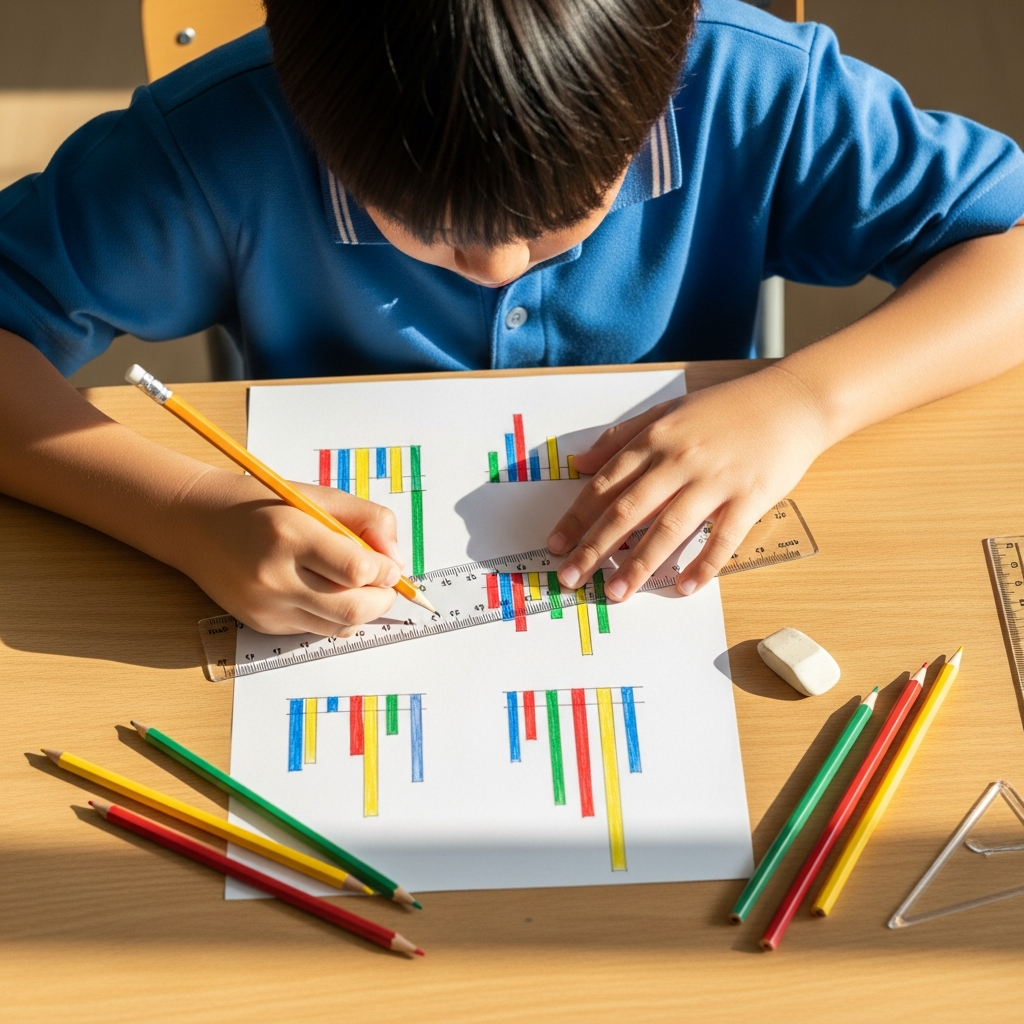
TLDR: P4 is the critical turning point where students shift from arithmetic to abstract problem solving using bar models. Parents should avoid re-teaching methods and instead guide children to visualize the logic or use AI tools like SgStudyPal for stress-free homework help.
Bar Model Math Problems: How to Help Your P4 Child Without Losing Your Mind
Primary 4 is the "turning point" in Singapore's primary school math curriculum. Students transition from concrete arithmetic to abstract problem solving, especially in P4 math bar model problems. If you have stared at a word problem, drawn rectangles, and lost your patience, you are not alone. The dining table has become a battlefield for many families. This guide breaks down the method so you can support your child without confusing them or losing your cool.
What Are Bar Models and Why Does MOE Use Them?
Bar models are visual representations using rectangular bars to show known and unknown quantities. The Ministry of Education (MOE) adopted this method to bridge the gap between concrete manipulatives and abstract algebraic thinking.
By Primary 4, children must handle multi-step word problems involving addition, subtraction, multiplication, and division simultaneously. Without a visual aid, young minds easily get lost in the numbers. The bar model method allows students to "see" the logic before calculating the answer. Instead of memorizing keywords like "altogether" or "difference," students learn to visualize relationships between quantities. This foundational skill is critical for Secondary school and the PSLE, where algebra becomes the standard tool.
The 3 Main Types of Bar Model Problems
Understanding the three core structures of P4 math bar model problems helps you recognize which strategy your child needs.
1. Part-Whole Model This is the most basic type, used for addition and subtraction where a total is split into parts.
- Example: Ali has 20 apples. Ben has 15 apples. How many apples do they have altogether?
- Visual: Draw two separate bars side-by-side. Join them with a bracket underneath labeled "Total."
2. Comparison Model This model compares two quantities where one is more or less than the other. This is a major hurdle for P4 students.
- Example: Ali has 20 apples. Ben has 5 fewer apples than Ali. How many apples does Ben have?
- Visual: Draw Ali's bar first. Draw Ben's bar below it, making it shorter by a specific amount labeled "5 fewer." The gap represents the unknown.
3. Before-After Model This is often the most difficult type, involving changes in quantity over time.
- Example: Ali had some money. He spent $10 and had $30 left. How much did he have at first?
- Visual: Draw a bar for the "After" state ($30). Add a segment for the "Spent" amount ($10). The full length represents the "Before" state.
Common Mistakes Children Make With Bar Models
Even when children understand the concept, execution errors lead to wrong answers and frustration. The most frequent mistake is misaligning the bars. In comparison models, if the start of the bars does not line up, the visual logic collapses, leading to incorrect calculations.
Another common error is confusing the operation. Students often see a number and assume they must add, ignoring the visual cue that a bar is shorter or longer. For instance, in a "difference" problem, they might add the two bars instead of finding the gap. Additionally, failing to label units (e.g., "apples" vs. "$") causes confusion in the Before-After model. These small errors compound quickly, resulting in a correct method but a wrong final answer.
How Parents Can Help Without Confusing Your Child
The best way to help is to ask guiding questions rather than re-teaching the method. If you use a method that differs from the school, it will confuse your child and undermine their confidence. Instead, ask your child to "draw the bars" for you. If they are stuck, ask, "Which bar represents the total?" or "Which bar is the longer one?" This reinforces their own understanding without you taking over the problem.
If your child is truly stuck and tears are flowing, use technology to bridge the gap. SgStudyPal's Snap & Solve feature allows you to take a photo of the homework problem. The AI analyzes the P4 math bar model structure and provides a step-by-step breakdown that is Singapore-syllabus aware. This gives your child the explanation they need without the emotional friction of a parent-teacher confrontation at the dining table.
Conclusion
Mastering bar models is a skill that takes time and practice, but it is the key to unlocking higher-level math. By understanding the three main types and avoiding common pitfalls, you can create a supportive environment for your child. Remember, the goal is not just to get the right answer, but to build the confidence to visualize the problem. With the right tools and patience, you can help your child conquer P4 math bar model problems and move forward to PSLE success.
Start using SgStudyPal for free today.using SgStudyPal for free today.